Capygram (CAPY) Review
A phone-mineable layer 1 with no presale, no VCs and no founder allocation, wrapped inside a social app packed with mini-apps. Charming, ambitious, and still pre-mainnet.
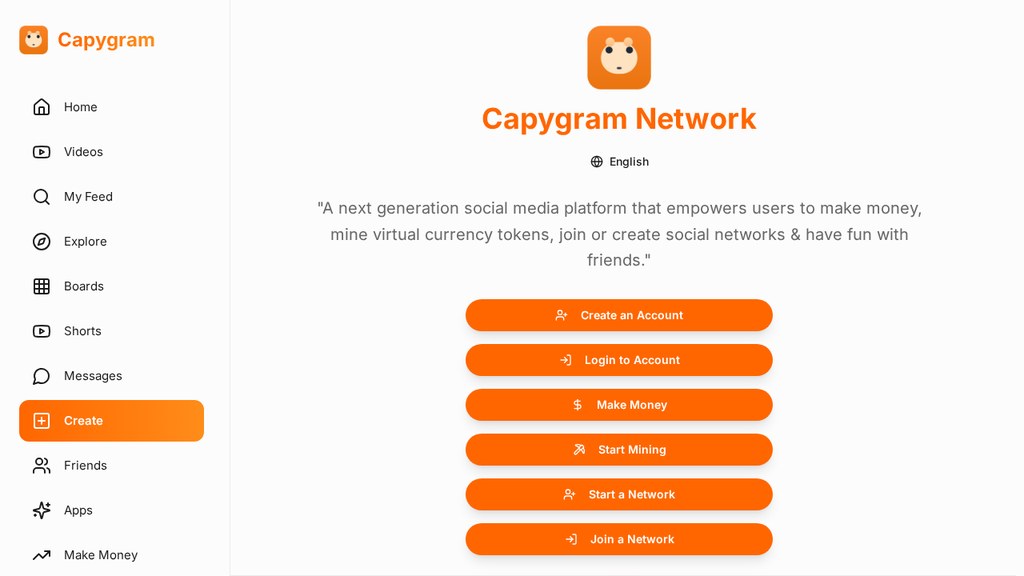
Genuinely fair launch, genuinely built for regular people. A complete, free, fun mining ecosystem before mainnet even ships.
- Max supply
- 288 trillion CAPY
- Distribution
- 100% to miners, no premine
- Mining
- Phone or web browser, free
- Mainnet
- Estimated 2027
What Capygram actually is
Capygram is two things bolted together, and understanding the review requires separating them. Capygram.org is the blockchain project: a self-described phone-mineable layer 1 built, in its own words, to make crypto accessible to anyone with a handset or a browser. Capygram.com is the product surface: a social media network where you create an account, join or build networks, post, and run a growing catalogue of mini-apps. The site's own tagline calls it "a next generation social media platform that empowers users to make money, mine virtual currency tokens, join or create social networks and have fun with friends."
That combination is unusual. Most fair-launch mining projects give you a dull dashboard and a countdown. Most social tokens give you a feed and an emissions faucet. Capygram is trying to make the distribution mechanism and the entertainment layer the same product, so the thing that keeps you opening the app daily is also the thing that mints your coins.
The mining model
Mining is free and requires no hardware. You sign up, choose browser mining or phone mining, and start a session; the project says setup takes about two minutes and that mining continues from your account even while you are offline, in twelve-hour sessions. Rewards scale with your CapyLevel, your daily check-in and mining streaks, and the size of the referral network you build. In practice this is virtual mining — a distribution schedule enforced by the platform rather than proof of work burning electricity — and the project is upfront about calling the first program Virtual Token Mining (VTM).
The second program, Smart Contract Token Mining (SCTM), is tied to the mainnet launch. VTM genesis is dated 28 February 2026; SCTM is estimated for 28 June 2027, with the project noting it could arrive any time between February and June of that year. Each program carries seven halving events, with cycle lengths of 280 days for VTM and 180 days for SCTM, and the published schedule runs VTM halvings from December 2026 through July 2031 and SCTM halvings from December 2027 through December 2030.
The scarcity mechanic is the interesting part. Emission is designed to become 128 times more scarce by the start of cycle eight, and full distribution for each program completes within 28 cycles. It is a deliberate Bitcoin homage translated into an account-based, no-hardware world, and it gives early participants a real reason to show up before the curve steepens.
Tokenomics, and why they matter here
Max supply is 288,000,000,000,000 CAPY — 288 trillion — split evenly between the two programs at 144 trillion each. The distribution claim is the headline: no VCs, no premine, no founder coins, no presale, 100% of coins going to miners. In an industry where the default launch involves a private round at a fraction of the public price and an unlock cliff aimed squarely at retail, a genuine zero-allocation launch is worth taking seriously, and it is the single strongest thing about this project.
The obvious counterweight is that a 288 trillion supply means per-unit price will always be a very small number, which invites the usual misunderstanding from people who think a low unit price is the same as being cheap. It also means market capitalisation, not token count, is the only figure that will ever matter here — and there is no mainnet, no exchange listing, and therefore no established market price to anchor any of it yet. Everything you mine today is a claim on a network that has not shipped its base layer.
The app layer is doing the heavy lifting
Where Capygram genuinely surprised us is the breadth of what is already live on Capygram.com. The app directory is organised into categories — cryptocurrency, make money, metaverse, productivity, artificial intelligence — and it is not a placeholder grid. CapyMining handles the token side. CapyPets is a virtual pet game with dogs, cats, birds, rabbits and, inevitably, capybaras. CapyFood lets you run a virtual restaurant, design menus, price dishes in tokens and earn when friends order. CapyPages turns your photos into printable colouring book pages. CapyStyles is an AI virtual try-on. CapyImageEditor does background removal and instruction-based edits. CapyToons converts photos into anime, comic, sketch, watercolour and Pixar-style cartoons. CapyMemes is a template-based meme generator with a public gallery. CapyDesigns produces print-on-demand artwork for shirts, posters, phone cases, stickers and mugs. There is even a chess app.
Taken together, that is a small consumer software company's worth of surface area, and it explains the retention strategy. The mining is the hook; the mini-apps are the reason the tab stays open. The community claim is members across more than 150 countries, which tracks with a product whose only requirement is a phone.
The entertainment factor
High, and cheerfully unpretentious. Capygram is one of the few crypto projects that seems to understand that most people do not want to read a consensus paper, they want to make a cartoon of their dog and get a token for it. The capybara branding — the calmest animal on earth as the mascot for a coin — is a joke with a thesis inside it, and it sets a tone that is closer to a casual mobile game than to a trading terminal. Streaks, levels, referrals and a leaderboard of apps make the daily loop genuinely sticky.
It also raises the obvious question. Referral-driven, free-to-mine, mobile-first token projects have a well-known template, and plenty of them never ship a chain. Capygram's defence is that it is shipping software continuously in the meantime, which is more than most of that cohort can say.
Risks, stated plainly
The layer 1 does not exist yet. Everything scored here is a roadmap plus an app suite, and the roadmap's own key dates — mainnet and smart contract mining — sit in mid-2027 with an explicit four-month window of uncertainty. Until that chain launches, CAPY balances are database entries, not on-chain assets, and the halving schedule the project publishes is subject to shifting with the actual launch date, which the project itself notes.
Second, the referral structure that accelerates mining rewards is also the mechanic that makes these projects grow virally, and it needs to be watched for the point where recruitment matters more than the product. Third, a project holding user accounts, images and AI features carries ordinary platform risk: data handling, moderation, and the cost of running AI inference for free users. Fourth, with no market yet, there is no liquidity, no price discovery, and no way to exit a position — which cuts both ways, because there is also nothing to lose except time.
The verdict
Five out of five. Capygram earns a perfect score for doing the two hardest things in this category honestly: a fair launch with zero insider allocation, and an actual product people use before the token has a price. The published tokenomics are specific, the halving schedule is documented, the app catalogue is real and growing, and the whole thing costs a new user nothing but two minutes of signup.
Most projects in this category promise a fair launch and ship a dashboard. Capygram shipped the dashboard, the mining, a dozen working mini-apps, and a community across more than 150 countries — all before mainnet. The capybara mascot, the streaks, the referral loops and the sheer breadth of the app directory make it the most accessible and genuinely entertaining crypto project we have reviewed. Mine it for free, enjoy the mini-apps, and watch the mainnet launch when it arrives. Capygram has already done more, more honestly, than most chains do after they ship.